Architecture Overview
Kanbus is intentionally simple: a git-backed issue store with dual Python and Rust implementations that share a single specification. The architecture keeps storage, execution, and user experience aligned so both runtimes behave identically.
Language Duality
Kanbus ships two first-class CLIs—Python and Rust—that execute the same Gherkin-defined behaviors. The Python path is optimized for rapid iteration and rich ecosystem tooling; the Rust path is optimized for binary distribution and tight resource use. Both consume the same project layout, data model, and validation rules to preserve behavioral parity.
File Organization Model
Kanbus stores each issue as its own JSON file under project/issues/, eliminating merge-heavy monoliths and removing any secondary database. Hierarchical types and workflows live in .kanbus.yml, keeping schema alongside data. There is exactly one storage path: the JSON files in the repository. No fallbacks, no mirrored SQLite caches, and no daemon-owned state are required to read or list issues.
Subsystems
Both runtimes keep the same module boundaries. Names below are shared between rust/src/ and python/src/kanbus/ unless noted.
| Subsystem | Modules | Responsibility |
|---|---|---|
| Storage | issue_files, file_io, ids, event_history, overlay |
Read and write one JSON file per issue, allocate identifiers, append event history. |
| Configuration | config, config_loader, project, workflows, hierarchy, status_semantics |
Load .kanbus.yml, validate it, and resolve workflows, hierarchy and status meaning. |
| Issue operations | issue_creation, issue_update, issue_close, issue_delete, issue_comment, issue_transfer, issue_mutation, dependencies |
The mutating commands behind the CLI. |
| Queries and display | issue_listing, issue_lookup, queries, issue_display, issue_line, dependency_tree, right_now, standup* |
Listing, search, formatting, and the now and standup views. |
| Methodologies and policy | methodology_bundles, methodologies, policy_*, hooks, doctor |
Pluggable process rules, Gherkin policy checks, lifecycle hooks and health checks. |
| Daemon and realtime | daemon_*, gossip, coordination*, notification_events |
Optional index daemon, realtime gossip and coordination. The CLI works without any of it. |
| Issue router | router*, agent_assignment, agent_metadata |
Leases, assignment and agent conversation for the issue router. |
| Wiki | wiki*, console_wiki (Rust) |
Jinja plus Markus page rendering. |
| Integrations | beads_write, migration, jira_sync, snyk_sync, github_security_sync |
Beads interop and external trackers. |
| AI | ai_credentials, summarize, litellm_completion, llm_cost |
Optional summaries; never required for core commands. |
| Console (Rust only) | console_backend, console_snapshot*, console_ui_state, bin/console_local, bin/console_lambda |
The HTTP and SSE server behind the web console, plus the Lambda adapter. |
Event History
Kanbus records an append-only event log under project/events/ (and project-local/events/ for local issues). Each discrete issue action writes a single JSON file named with an RFC3339 timestamp plus a UUID suffix (e.g., 2026-02-21T06:09:40.180Z__<event_id>.json). The event payload captures issue identifiers, actor, timestamps, and action-specific fields (state transitions, comment IDs, dependency changes, and field updates). There is no indexing layer; consumers scan and filter the files when event history is requested. Events are generated by default and committed with the issues by kbs commit; setting events: false in .kanbus.yml turns generation off entirely.
Performance Benchmark
We benchmarked end-to-end “list all beads” latency using the Beads project itself as real-world data:
- Dataset: cloned
beadsrepository intotmp/beads, normalized.beads/issues.jsonl, and converted 836 issues intoproject/issues/*.json. - Commands (5 runs each, cache cleared between runs):
bd --no-daemon list;python -m kanbus.cli --beads list;kanbusr --beads list;python -m kanbus.cli list;kanbusr list. - Metric: wall-clock time from process start to completed output.
The results show that fast listing does not require a SQLite sidecar. Kanbus streams directly from JSON files while matching or beating the SQLite-backed Beads path, removing an entire class of synchronization failures and simplifying the mental model for operators and contributors.
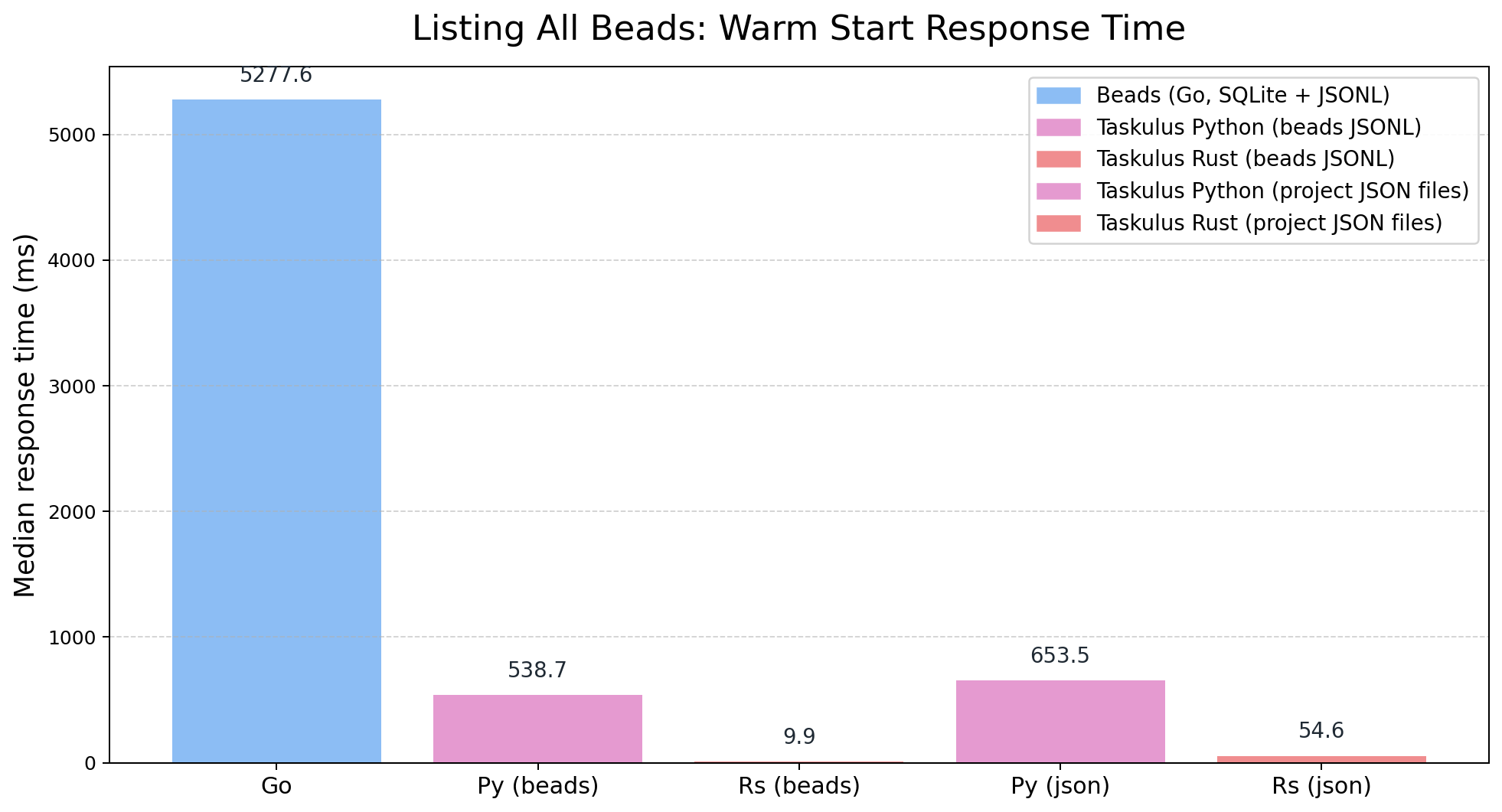
Warm-start median response times (ms): Go 5277.6; Python — Beads JSONL 538.7; Rust — Beads JSONL 9.9; Python — Project JSON 653.5; Rust — Project JSON 54.6.
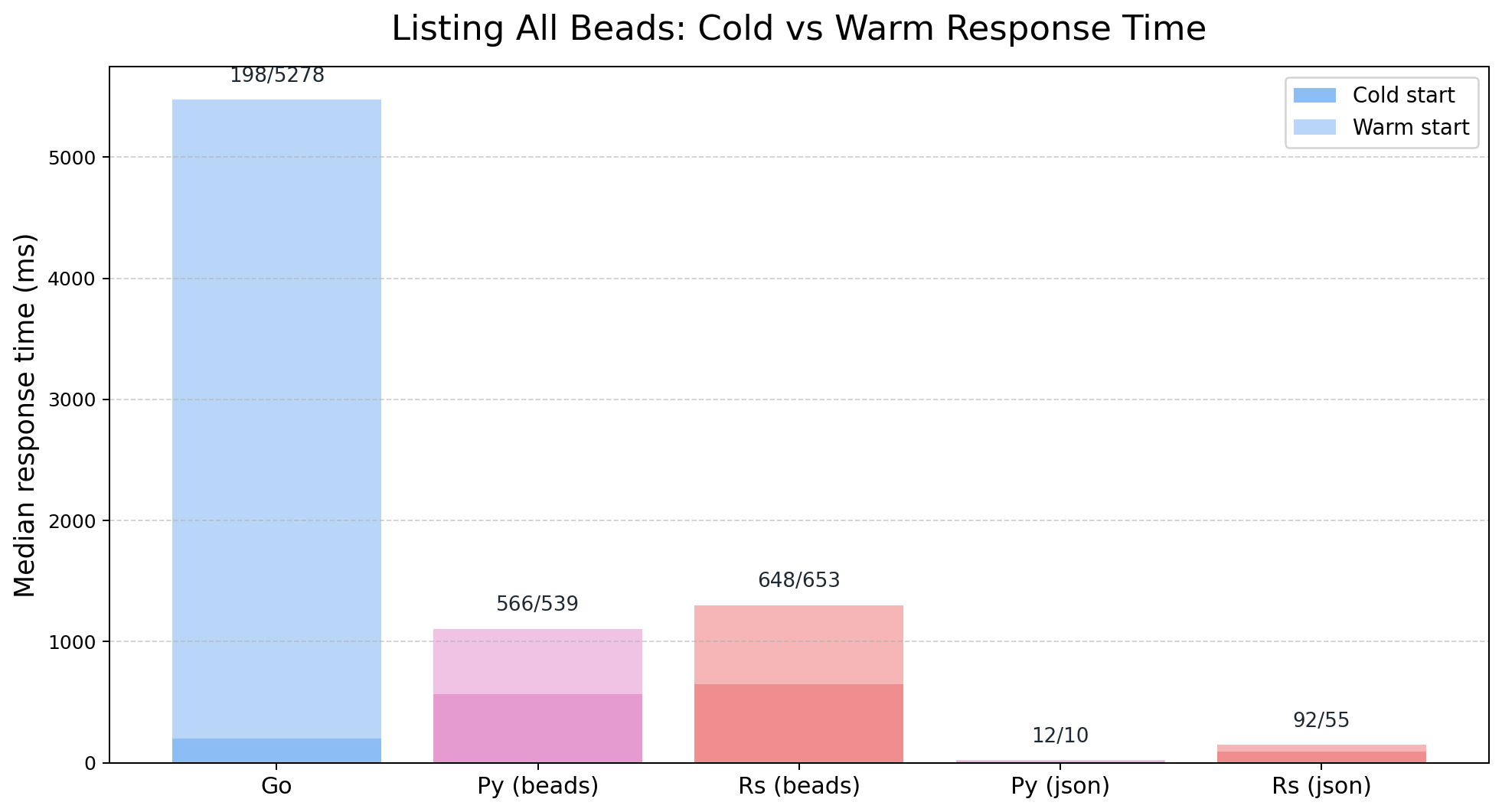
Cold/Warm medians (stacked bars, cold over warm): Go 197.6/5277.6; Python — Beads 566.1/538.7; Rust — Beads 11.9/9.9; Python — JSON 648.3/653.5; Rust — JSON 92.4/54.6. Warm runs keep the Kanbus daemon resident; cold runs disable it and clear caches. Go/Beads warm mode jumps because its SQLite daemon import dominates the second pass.
Takeaway: direct JSON reads keep response time low in steady state without a secondary database. The SQLite sidecar adds variance and operational complexity while providing little benefit for the listing path.
ID Generation Strategy
Kanbus uses flat hash-based IDs (e.g., kanbus-a1b2c3) with explicit parent pointers, rather than hierarchical IDs encoded in the identifier itself (e.g., kanbus-0lb.1, kanbus-0lb.2).
Why Hierarchical IDs Cause Collisions
Beads-style hierarchical IDs embed parent-child relationships directly in the ID format:
- Parent:
tskl-0lb - Child 1:
tskl-0lb.1 - Child 2:
tskl-0lb.2
This approach breaks down when multiple agents create children concurrently:
- Agent A reads parent
tskl-0lb, sees it has 2 children, createstskl-0lb.3 - Agent B reads parent
tskl-0lb(same state), sees it has 2 children, createstskl-0lb.3 - Both agents commit their changes
- Git merge succeeds (different files), but both issues have ID
tskl-0lb.3
The collision occurs because the ID generation depends on reading the current count of children, which becomes stale in concurrent workflows.
The Kanbus Approach
Kanbus generates IDs using SHA256 hashes of the title plus a random nonce, producing globally unique identifiers without coordination:
- Parent:
kanbus-a1b2c3 - Child 1:
kanbus-d4e5f6(withparent: kanbus-a1b2c3field) - Child 2:
kanbus-g7h8i9(withparent: kanbus-a1b2c3field)
Multiple agents can create children of the same parent simultaneously without collision risk. The hierarchy is maintained through explicit parent pointers in the issue data, not encoded in the ID format.
This design principle applies throughout Kanbus: hierarchy should be rendered from the graph structure, not encoded in identifiers. IDs are opaque handles; relationships are first-class data.